Showing posts with label technology. Show all posts

Seems obvious, but apparently it's not!

This weekend I got an email from Campaign for a Commercial-Free Childhood which had a link to this year’s TRUCE (Teachers Resisting Unhealthy Children's Entertainment) Toy Action Guide: Toys of Value list, released in time for the holidays. While Hubby and I aren't at the stage where we're buying many toys for the baby-to-be yet (although I can't seem to resist books!), I found the list interesting, and I really like that it reinforces the value of non-electronic toys. While every child will have some battery operated toys, I find a lot of the ones on the market (even the so-called 'educational' toys) to be glorified babysitters which don't give kids much human interaction, and don't let them be creative. I'd prefer that my children have more traditional toys that foster imaginative play.

The email I received also linked to an article that talks about the Toys of Value list, and the prevalence of electronic toys on the market today: Kids Don't Get Building Blocks of Learning from High-Tech Play, which made some interesting points:

Contrast [the Toys of Value list] with the Toys ‘R’ Us 2006 Fabulous 15 Best of the Holiday list, which includes only two toys that don’t use batteries or a screen, or with Hasbro’s Something for Everyone 2006 Holiday list, which boasts the return of the Baby Alive Doll, whose updated version requires four batteries so she can ‘‘eat and poop, just like a real baby,’’ and Star Wars Force Action Lightsaber, ‘‘the most authentic lightsaber-playing experience ever,’’ batteries not included. Of the 26 toys included, all but four are electronic or require batteries.
...

Levin and others who study the relationship between toys, play, and development say toys with electronics bypass the process by which young children learn about cause and effect, including cause and effect of the human kind, such as body language and nonverbal clues. The more high-tech toys a child has and the younger he or she is when they’re introduced, the bigger the potential problem. ... "These kinds of toys entice parents ..... but they undermine the process of being an active agent, of being a problem solver," Levin says.
...

"There’s a critical part of the brain thought to be responsible for reading signals and feeling empathy and relating to other people, part of the orbital prefrontal cortex, that develops early on. But it needs input from real-life people," says Healy, author of Your Child’s Growing Mind.

The Toys of Value guide lists specific toys, both "good" and "bad", and offers some general tips for choosing and avoiding children's toys. The 8-page report has some great suggestions and insights, and I encourage you to read it, but since I know some of you won't, I'll list some of the DOs and DON'Ts here:

Choose toys that promote:

photo by Anissa ThompsonDramatic play
Helps children work out their own ideas about their experiences. Provides a powerful way of learning new skills and a sense of mastery. Blocks are a classic toy that children never outgrow. Adding props encourages, inspires, and extends children's play. Props have the ability to help children recreate real life experiences as well as invent imaginary ones.

Manipulative play with small play objects
Develops small muscle control and eye-hand coordination. Teaches about relationships between objects, essential for understanding math and science. Examples: construction sets and toys with interlocking pieces (Lego, Lincoln Logs), puzzles, pegboards, miniature models, parquetry blocks.

Creative arts
Encourages self-expression and the use of symbols, a vital skill for problem solving and literacy. Develops fine motor skills. Examples: poster and finger paints, assortment of blank paper of all sizes and colors, crayons and markers, scissors, glue, recycled materials, stamps, clay, weaving kits.

Physical play
Promotes healthy body awareness and coordination. Provides opportunities for social interaction. Ideas for toy swaps: bikes, scooters and other wheeled toys, climbing structures.

Game playing
Teaches about taking turns, planning strategy, sequencing, rules, and cooperation. Examples: board games like checkers and chess, card games, jacks.


Try to avoid toys that:

Exploit parents' desire to be "good parents."
Take advantage of parents by promising to make kids smart by teaching the alphabet or numbers at too young an age. These toys undermine the development of appropriate play.

Turn TV into the controller of play
Toys that plug into TV sets so children interact with the TV screen, turn playtime into “screen time.” Frenzied pace and programmed actions can increase children’s expectation for elaborate bells and whistles and make children observers rather than participants in their own play.

Lure infants and toddlers into the electronic media culture
These toys control and limit play and creativity and get children used to being entertained. Very young children learn best by interacting with people and seeing their effect on real things. The American Academy of Pediatrics (AAP) recommends no screen time before age 2.

Make appearance, makeup and sexiness the focus of play
Channel girls into very narrow play scripts where how you look—including being thin and wearing make-up and skimpy clothes—and what you can buy is what matters most. Focus on highly sexy appearance and behavior confuses children.

Heighten gender divisions between boys and girls
Dictate that specific toys and interests are only for boys or only for girls. Encourage rigid gender divisions and stereotyped play. Lead to choosing toys based on gender, not play value of a toy.

Make violent themes the focus of play
Often linked to TV programs, movies, and video games, these toys make violence seem entertaining and fun. Channel children into imitating violent TV scripts and anti-social play that undermines positive lessons caring adults try to teach.

Link non-nutritious food to toys and play
Create an easy market for unhealthy, brand-named foods and their logos and early brand loyalty. Products like these undermine healthy eating and contribute to obesity and eating disorders.

Technorati tags: , , , ,

Roundup

Quick roundup of interesting things:


Technorati tags: , , , , , , , ,

Photoshop 'magic' & self esteem

"No wonder our perception of beauty is distorted."

I like these commercials.


Thanks to Weary Parent for the video of the model - I hadn't seen that one before!

Link, link and link (in case the video players don't work for you).

Technorati tags: , , , , ,

Mickey wants your fingerprints

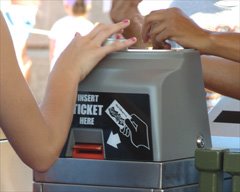
Disney World has started using fingerprint scanners at their park entrances to ensure that the person using a ticket is the person who bought it. Naturally, privacy experts are concerned, as they argue that "Disney's use of the technology 'fails a proportionality test' by requiring too much personal information for access to rollercoasters."

When I went to Disney World in 2004, they didn't have to scan any body parts to let me into the park; only my ticket. If I were to go back now, I'd be very wary about letting park attendants scan my fingerprints. Although Disney says that the biometric data is purged 30 days after the park ticket expires, the potential for misuse of the information if someone were to hack into their system is a definite concern.

It's also disturbing that "There are no signs posted at the entrances detailing what information is being collected and how it is being used". I like to know what is done with my personal information, and I think park visitors should be told up-front, rather than having to find and ask an employee (who may or may not be well-informed or able to provide details).

For those of you wary of this new technology, keep this tip in mind if you're heading to the House of Mouse: although it's not advertised, visitors who object to the new technology can provide photo ID instead.

The downside of technology

Tidbits

For those stressful days, take comfort in the fact that Hallmark's Screaming Banshee understands how you feel! (via Man Eegee)


Saskboy alerts us to the fact that Microsoft has ended support for Windows 98 and Windows ME. This means no more security updates, so upgrade to a newer version of Windows (or Linux, or buy a Mac) to protect your computer.


Disney is cool again. Sadly, I suspect that even so, I, with my large collection of Disney movies, am not. ;) My in-laws are spending the winter in Florida, and Hubby and I may go for a visit, depending on what's going on around here. I don't think I can go to Florida without visiting Disney World again though - I loved it so much the first time!

"If one would give me six lines written by the hand of the most honest man, I would find something in them to have him hanged."

The quote in the title is from Cardinal Richelieu, and according to security expert Bruce Schneier, the Cardinal truly understood the value (and dangers) of surveillance.

Here is an excerpt from a Wired News article by Bruce Schneier about the value of privacy:
(by the way, his blog Schneier on Security is great, check it out)

"Privacy is an inherent human right, and a requirement for maintaining the human condition with dignity and respect. ... We do nothing wrong when we make love or go to the bathroom. We are not deliberately hiding anything when we seek out private places for reflection or conversation. We keep private journals, sing in the privacy of the shower, and write letters to secret lovers and then burn them. Privacy is a basic human need.

Two proverbs say it best: Quis custodiet custodes ipsos? ("Who watches the watchers?") and "Absolute power corrupts absolutely... Privacy protects us from abuses by those in power, even if we're doing nothing wrong at the time of surveillance."
...

Too many wrongly characterize the debate as "security versus privacy." The real choice is liberty versus control. Tyranny, whether it arises under threat of foreign physical attack or under constant domestic authoritative scrutiny, is still tyranny. Liberty requires security without intrusion, security plus privacy. Widespread police surveillance is the very definition of a police state. And that's why we should champion privacy even when we have nothing to hide."

That's one of the best arguments against surveillance that I've read in a long time. It's simple, but true.

Thanks to Erin R. for posting about this on her blog, The (Mis)Adventures of a Gringa (soon to be) in Costa Rica!

Technorati tags: , , , , , ,

For the Firefox fans...

This video is TOO funny!

Technorati tags: , , ,

What's a favicon?

A favicon is an icon that shows up in the address bar of your web browser, just before the "http://", and next to the website's listing in your bookmarks (Using Firefox? Mine's a big blue dot). If you're using the Firefox browser, I'm sure you've seen them on a lot of websites. Note: While technically favicons should work in Internet Explorer, I can't see anyone's except mine.


Lifehacker has a link to a tool for creating a favicon from any picture (oh, and instructions on how to get it to show up). It's a simple way to customize your website's bookmark and address bar (really simple - if you update your own website or blog, you can handle it). Just find a picture you like, that will look good reeeeeally small.

_

On an entirely unrelated note, spring is definitely here. Now while the impending arrival of spring and all of its sunshine has excited me for a while, now I remember the bad part about spring in our house: spiders.

I have become a shoe-wielding maniac.

Sometimes I miss our fourth floor apartment.

Technorati tags: ,

Internet Explorer - more security vulnerabilities

Just an FYI – Microsoft has found 3 more security vulnerabilities in Internet Explorer. They’re working to fix them, but won’t have patches available until April 11th. Update your computer with Internet Explorer downloads here.

BBC News article:

“The first of the problems discovered in Internet Explorer will simply make the browser program crash if it is used to visit a specially crafted webpage. The other two vulnerabilities are potentially more serious because they can be used to take control of a victim's computer.”

Technorati tags: , ,

P2P downloading - not all bad?

The Canadian Recording Industry Association has submitted an interesting study on P2P downloading and its effect on the music industry to the CRTC. Once heralded as the downfall of CD sales, new statistics show that downloading is not a major factor behind consumers' decisions to buy less music (cost and lack of interest in new releases are the biggest reasons). The study showed that people who do download through P2P services often buy that same music.

It's quite an enlightening study because it counters the claims that major record labels and recording industry associations have been making for years. While no one would argue that P2P downloads have had an effect on the recording industry, it seems that the detrimental effects have been overestimated. Perhaps now the major labels will spend more effort promoting unique artists and examining cost-for-value issues.

That being said, I will be eternally frustrated by the people who spout "record companies make too much money" as an excuse for downloading and rarely purchasing music they like. While major labels do make a nice profit from every sale, by not purchasing music, people are not only affecting the record company and performer, but the writers, producers and studio musicians who work on an album. They are the forgotten artists in this whole debate, who can't try to recoup their losses through tours and merchandise sales. Not to mention the impact on independent record labels who are working to promote diverse music, and need to make a profit to continue their work.

See lawyer Michael Geist's article about the study (found via Saskboy). It's interesting that the CRIA hasn't posted information about the poll on their website yet. The top news item listed today (even though it isn't the most recent one) reads: "Music sales in Canada fall 4 percent in 2005: downward trend resumes as international body calls on Canada to act on copyright reform and curb illegal file swapping".

March 28 edit: It seems that in the past few days the CRIA has posted the submission on their website, dated March 15 (which is the submission date, not the date the news item was posted on the website). The title, however, CRIA Submission to the CRTC - Review of Commercial Radio Policy, does not allude to the interesting findings in the report, so I'm skeptical about how many people will click on the link.
Pollara, the firm that conducted the poll on behalf of the CRIA, has fired back at Michael Geist, calling him "impertinent and presumptuous". Read his response here (found via BoingBoing).

Technorati tags: , , , , ,

ClearType - A nifty Microsoft feature that I'd never heard of before!

Maybe I'm just way behind the times, but up until today, I had no idea what Windows XP's ClearType feature is. The basics: ClearType is a feature in XP that improves the readability of text on your computer (websites, email, word processing, the whole shebang). It makes the shape of letters look more like they do on the printed page.

I just turned it on, and wow, does it make a difference! The text on my computer screen is SO much easier to read now (Seriously. You don't realize how much strain 'regular' text puts on your eyes until you switch).

This article in Quick Online Tips explains it much better than I can (and offers before and after pictures!), so go check it out. It only takes a couple of minutes, and you have nothing to lose, because you can turn it off at any time.

I read about this on Lifehacker - full of great tips!

Custom blog T-shirts

SnapShirts will scan your blog and create T-shirts featuring words commonly used on your blog.

The word list is customizable, so if you don't like some of the words that show up on the scan - edit away! Visit the site and click "Custom" to try it out.

Here's mine:

It's amazing what a little airbrushing can do...

Check out the portfolio of Glenn Feron, retoucher to the stars, to see before and after photos of Halle Berry, Alicia Keys, Usher, and many more.

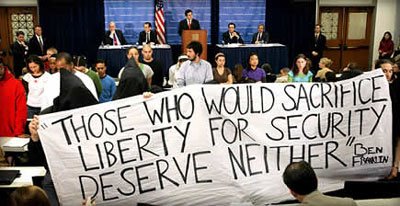
Future American lawyers protest Attorney General's speech

(originally posted January 30th, 2006)

Quoted from Insomnia:

"Alberto Gonzales spoke before law students at Georgetown [on January 24th], justifying illegal, unauthorized surveilance of US citizens, but during the course of his speech the students in class did something pretty ballsy and brave. They got up from their seats and turned their backs to him. ... [A]dditional students came into the room, wearing black cowls and carrying a simple banner, written on a sheet."


The Attorney General's speech was followed by a panel discussion, where one of the students' profs said:

"When you're a law student, they tell you if say that if you can't argue the law, argue the facts. They also tell you if you can't argue the facts, argue the law. If you can't argue either, apparently, the solution is to go on a public relations offensive and make it a political issue... to say over and over again "it's lawful", and to think that the American people will somehow come to believe this if we say it often enough. In light of this, I'm proud of the very civil civil disobedience that was shown here today."

- David Cole, Georgetown University Law Professor

Links to info on Insomnia, BoingBoing, and ABC

Rules for listening to your CDs

(originally posted January 3rd, 2006)

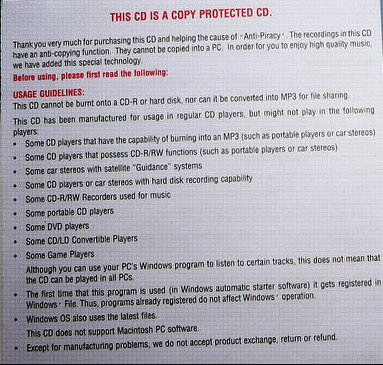
Coldplay's new CD has a HUGE list of rules, and stipulates that the copy protected CD might not play in any device that has the capability to copy, including: DVD players, car stereos, portable CD players, game systems, and computers. Oh, and of course, you can't download songs to your MP3 player or iPod.

According to Boing Boing,

"these rules are only visible after you've paid for the CD and brought it home, and as the disc's rules say, 'Except for manufacturing problems, we do not accept product exchange, return or refund,' so if you don't like the rules, that's tough."

Canadian Recording Industry Association poll - accurate?

(originally posted January 3rd, 2006)

Those of you who know me, know that the music industry has been a large part of my life, which (combined with my law school education) is probably why I find Intellectual Property issues so fascinating.

The CRIA recently released the figures from a recent poll, stating, among other things, that that 91% of Canadians are in favour of copyright protection. No big surprise there.

Michael Geist, one of Canada's leading privacy experts (and the Canada Research Chair in Internet & E-commerce Law), has written an interesting editorial about the poll, and I agree with his opinions on this issue, as I often do. He says:

"What is most important about this poll, however, is what it doesn't ask. What percentage of Canadians would say that the law should protect consumers against the secret installation of copy protection programs that threaten the security on their computer? What percentage of Canadians would say they should be entitled to view a store-bought DVD in their homes regardless of where it is purchased? What percentage of Canadians would say that they should be entitled to make a copy of their CDs to listen to on their iPod? What percentage of Canadians are aware of the $140 million that has been collected under the private copying system, the majority of which goes to Canadian artists? These are the sorts of questions that must be asked for this poll to have any real credibility since my guess is that the numbers [of people who see copyright as an election issue] would be even higher. Canadians are deeply troubled by issues such as the Sony Rootkit, DVD regional coding, and the shortcomings of the private copying system and copyright policy must take these issues into account."

Text Messages Used as Evidence in Court

Transcripts of text messages have been admitted as evidence in the Brampton, Ontario court case of two teenagers accused of drowning their alcoholic mother in a bathtub. Sick crime, but it shows the emergence of an interesting Canadian precedent.

Link to story

Mobile Voting

(originally posted November 4th, 2005)

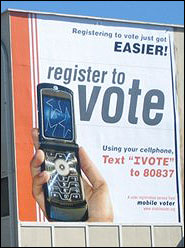
Here's an interesting website about mobile voting and voter registration. Thus far, mobile technology has only been used in a rudimetiary way by North American politicians and governments, but the city of San Francisco has launched a campaign for mobile voter registration. The campaign, largely geared towards youth, is being advertised on billboards, on taxis and at concerts. Voters who register through SMS (using a short code) will also be sent a text message on election day, reminding them to vote.

Links to stories in CNET, 160 Characters and the official website blog, Mobile Voter

Why you should always proof-read (not just spell check) court documents...

Link to document